Tuesday, 30 June 2015

Nerdcore - Mes en Scene


Though nerdcore rappers rhyme about anything from politics to science fiction, there are some perennial favorites in nerdcore subject matter, including Star Wars, role-playing games, science, fantasy and computers. There are hip hop artists who have recorded compositions which focus on similar topics, but who are not generally considered nerd core, this may relater to Dan because he only uses certain aspects of the genre. However the artist doesn't have to concentrate on those topics to be nerdcore: most of the songs by Frontalot do not focus narrowly on stereotypically nerdy topics. The difference is largely one of self-identification; the group Blackalicious does not identify as "nerds", while Frontalot does. My artist claims to be 'nerdy' but doesn't typically identify himself as a nerd. This is important for the music video because my artist has to be presented as nerdy without the nerdy identity, this makes it very hard to think about mes en scene because the artists identity is a strange mis of typical hip hop and nerdcore

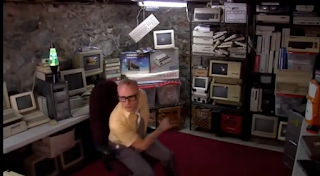
 Within the Mes en scene of this Nerdcore artist there are many old bits of technology that denote the artists nerdyness. Throughout this music video we can see old keyboards, computers and folders. The setting of the whole video seems to be his parents basement, which is something closely considered with nerds. The clothing of the artist is coloured very plain this shows off his apparent dull personality. Furthermore the glasses specifically shout nerd to the audience. The reason I am looking at this is because I want to tease the audience with the mrs en scene because they would be expecting these types of props and costume in nerdcore. However because my artist isn't closely linked to the genre I have more flexibility with hat I put in the frame. I can either focus on the character that Dans pretending to be or I can choose to look at Dan himself.



Monday, 29 June 2015

Green Screen Music Videos


The music industry is not just a competitive market in terms of music but they also have the challenge of music videos. This is because of the internet and TV, which all are based of visual entertainment therefore this forces music producers to incorporate a video in order to market their product. Furthermore a green screen is substantially cheaper than going to loads of different locations, this further saves time because all the scenes take place in one area. However the preparation has to be planned well because lighting is extremely important in order to make the effect work.


The example above is a YouTube channel called Epic Rap Battles of History. These content creators use the full effect of green screens to re-create scenes from the films they are referencing and to place their characters on screen. I would love to use this technique in order to create an extravagant scene in which my artist is in many different locations, however the cost of lighting and the screen for a technique I'm not used to using is very risky.


Saturday, 27 June 2015

Two more theories

Users and Gratification:

This theory is  to the hypodermic needle theory because it proposes a different idea where the audience is active instead of passive.

The theory is split into five different categories/needs:

Cognitive need - The viewer wants to learn from the source as much as they can therefore it is their choice to interact with the media.

Effect need - This is the viewer mood and emotions, they may look at some media that shares the same emotions with them or contrast them in order to get emotional pleasure.

Personal integrated need - The viewer chooses to look at media to boost their own self confidence.

Social Integrated need - Socializing about a text with friends and family. This may result in a new social group or fan club.

Personal Escape - The idea that they want to escape their own troubles in life.

 2 Step Flow:

The two-step flow of communication model,  says that most people form their opinions under the influence of opinion leaders, who in turn are influenced by the mass media. So according to this model, ideas flow from mass media to opinion leaders, and from them to a wider population. 

These ideas will help construct my media work because I will understand the further purpose of the product and why our viewers interact with it.

Wednesday, 24 June 2015

The Hypodermic Needle Theory


History and Orientation: 
The "hypodermic needle theory" implied mass media had a direct, immediate and powerful effect on its audiences. The mass media in the 1940s and 1950s were perceived as a powerful influence on behaviour change.
Several factors contributed to this "strong effects" theory of communication, including:
- The fast rise and popularization of radio and television
- The emergence of the persuasion industries, such as advertising and propaganda
- The Payne Fund studies of the 1930s, which focused on the impact of motion pictures on children, and
- Hitler's monopolization of the mass media during WWII to unify the German public behind the Nazi party

The Theory:
The theory suggests that the mass media could influence a very large group of people directly and uniformly by ‘shooting’ or ‘injecting’ them with appropriate messages designed to trigger a desired response. 
The idea of a bullet or injection provides a specific target; a bullet fired from the "media gun" into the viewer's "head". This creates the idea that media is a dangerous means of communicating because the receiver or audience is powerless to resist the impact of the message. There is no escape from the effect of the message in these models. This means that a passive audience could suffer an impact of the "bullet".

Advantages:
- Use statistics to create an accurate representation of trends within audiences, this is a reliable source of information.
- Large Number of participants in order to create long lasting effects. 

Disadvantages: 
- Audiences may change their views from time to time making it hard to analyse the reception of information. Furthermore audiences are more aware of these messages and may not want to make a decision based upon them.
- The media is open to interpretation this can change the message and the message can be to simplistic and makes observing attitudes harder.

Tuesday, 23 June 2015

Music Video - History/Purpose


To understand how to make a music video I must first research the purpose of one and the history behind them. While researching this I found a timeline from the first recorded 'talkies' all the way up to 2010. This shows the ever growing expansion of music videos over the past 89 years.
Although they are all classed as 'music videos' the evolution of their purpose has changed with time, for example the original 'talkies' were the first step from the short film to a music video because these involved sound and visuals in order to provide entertainment. These were played in jukeboxes on a 16mm bit of film and this is where it is believed to have started the idea of a music video. This quickly changed into the first music video: St Louis Blues. This was created in 1929 and was first shown to audiences in theaters in 1932, the fact that these short films with a single music track music were even played in theaters shows the new founded popularity  these music videos. This then gave way for the music video to promote the music because it revived the song after three years. Long after this Disney made a short film with mickey mouse called 'Fantasia Mickey The Sorcerer's Apprentice'. Disney often used music as a device to tell a story in their films but this was the first one to be classed as a short film to music. This was probably the first ever music video I saw as a child because after all it's Disney. The short film tells the story of Micky through music, this set the way for music videos because it allowed a story to be told visually with a consistent sound track. 

This then created the 'Promotional Music Video' which changed the purpose for music videos in the 1940's. These videos usually promoted popular jazz artists at the time. These videos were further used with the rise of TV in the 1950's-60's allowing for more popular stars to get involved and promote the musicians. The rise of television and visual entertainment provided popular artists with new promotional material, for example the Beatles create a series of 10 short films in order to promote their new album in 1965. After the popularity of these videos became widespread MTV launched their own music channel and played the music videos 24hrs a day; this made music videos a central part to promoting an artists image to the public in the 1980s. In the 1990's directors were given credit for their work in music videos making them become more appealing to make for the people behind the camera. With the music industry exploding with new content for fans Apple created iTunes in order for music videos to be downloaded in 2005, this year also saw the start of YouTube which evolved into a major platform for music artists. This meant that artists could see their views and interact with fans unlike television. Lady Gaga then hit a billion views with her song poker face in 2010 however this was overshadowed by Psy who hit 2 billion in 2012. I want my product to be a great modern promotional music video that uses the conventions of an internet video in order to capture more of the viewers on YouTube. My product will use the internet like the more modern of the music videos in order to promote the artist.


Music Video - Style Choice

The style of music video that inspired is a series run by YouTube called "YouTube Rewind", the series consists of recapping the whole of the past year on YouTube, which is brought together through a unique music mix of popular tracks from that year. I want to use similar transitions as the directors used in these videos because the help the flow of the video and help get everything in to the video. Lastly the style is closely associated with the internet, which is what I want to achieve.